Loading...
History
From a gift on the waterfront in 1998 to Norway's stadium of champions
Few stadiums have an origin story like Aker Stadium's. Built in little more than a year on the shore of the Romsdalsfjord and given to the town as a gift by two of Norway's best-known businessmen, it has gone on to host league title celebrations, cup triumphs, internationals and visits from some of Europe's biggest clubs — all while keeping its defining feature: the view where fjord and mountains meet football. This is the story, era by era.
1911–1996
The Road to the Waterfront
Molde FK was founded on 19 June 1911, yet for most of the club's existence its home ground never quite matched its ambitions. After long spells in the lower divisions of Norwegian football, Molde climbed to the second tier in 1970 and sealed promotion to the top flight with a 5–1 win over Sogndal on 16 September 1973. They then stunned the country by finishing second in their 1974 debut season, a single point behind champions Viking, with striker Odd Berg becoming the club's first top-flight leading scorer on 13 goals.
Home matches in those days were played at Molde idrettspark, but by the mid-1990s it was obvious that a football town like Molde deserved a modern arena. Businessmen Kjell Inge Røkke and Bjørn Rune Gjelsten decided to build one — and picked a site that few stadiums anywhere in the world can rival.
1997–1998
A Gift by the Fjord
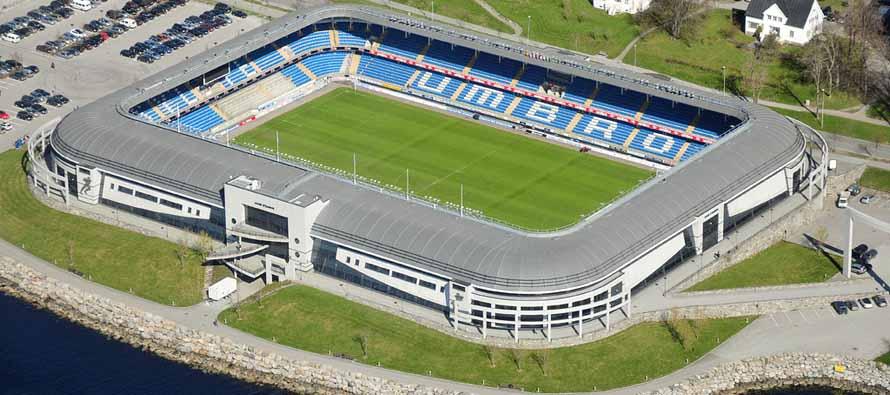
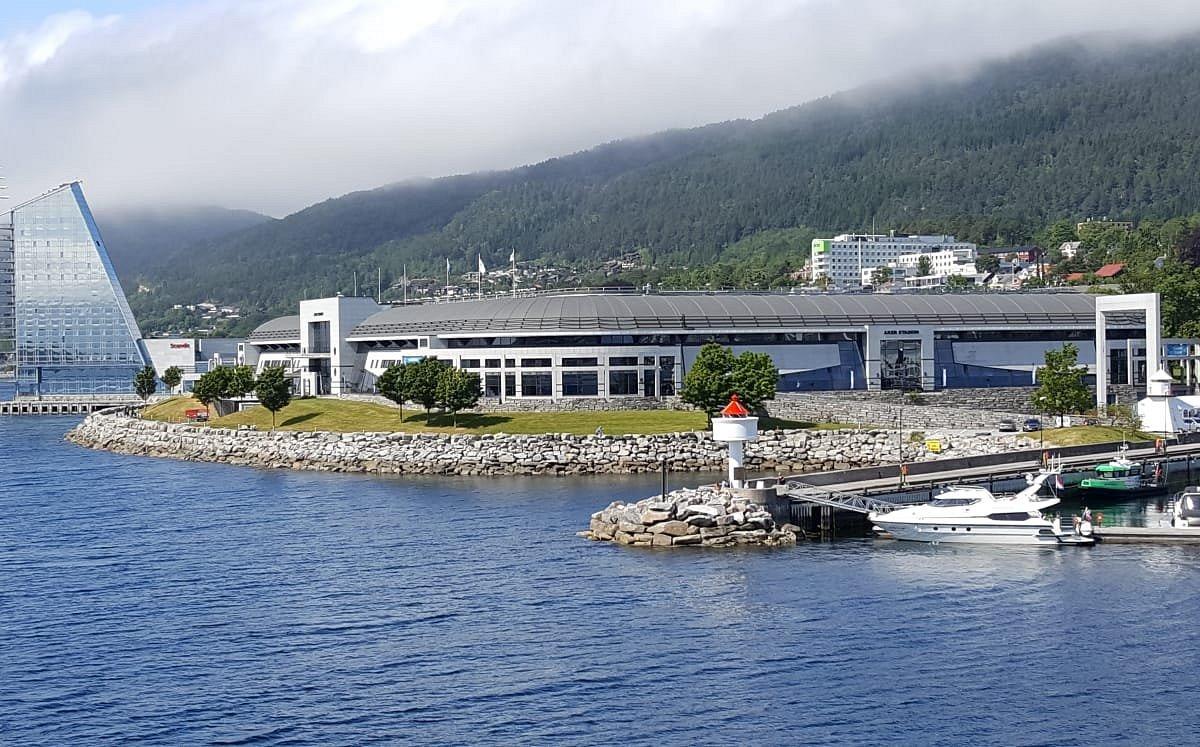
Construction began in March 1997 on a plot at the very edge of the water, with the Romsdalsfjord lapping at the stadium's doorstep and a panorama of the Romsdal peaks behind it. Architect Kjell Kosberg designed a compact bowl that keeps the stands tight to the pitch and the fjord in constant view — and it is this setting, more than any single result, that has made the ground famous: hardly anywhere else in Europe is top-level football played quite so literally at the water's edge.
The final bill came to 212 million kroner — roughly 160 million of it for the stadium works themselves — financed almost entirely by Røkke and Gjelsten as a gift to the town, which is why locals soon nicknamed the ground "Røkkeløkka", Røkke's field. On 18 April 1998 the stadium was officially opened by Prime Minister Kjell Magne Bondevik, and Molde celebrated the move from the old idrettspark by beating Lillestrøm 4–0 in front of 13,010 spectators. Fittingly odd for a fairy-tale day, the first ever goal at the ground was an own goal by Lillestrøm defender Tommy Berntsen.
1998–1999
A Record Crowd and a Rebuild
The attendance record arrived in the stadium's very first autumn: on 26 September 1998, 13,308 people watched the league meeting with Rosenborg — a figure that still stands and, in fact, can never be beaten at today's capacity. When Molde eliminated Mallorca on away goals in 1999 to reach the Champions League, the ground had to be converted into an all-seater: seats installed on the lower sections behind the goals cut capacity from the original 13,308 to the current 11,249.
1999–2015
European Nights on the Fjord
Reaching the 1999 group stage made Molde only the second Norwegian club ever to play in the Champions League, and that autumn Real Madrid, Porto and Olympiacos all travelled to the fjord town — the grandest stage Norwegian club football can offer. The highlight was a 3–2 home win over Olympiacos.
Sixteen years later the arena hosted another famous European campaign: in the 2015/16 Europa League, Molde topped a group containing Fenerbahçe, Ajax and Celtic, and the 3–1 home victory over Celtic in October 2015 remains one of the most cherished results ever recorded at the ground. In the round of 32 in February 2016, even Sevilla — the eventual winners of the whole competition — were beaten 1–0 here through an Eirik Hestad goal, though the Spaniards went through on aggregate.
2006–2014
A New Name, First Titles and Artificial Turf
On 3 May 2006 the ground was renamed from Molde Stadion to Aker Stadium, after Røkke's company Aker. Five years later came the reward the whole town had waited for: under manager Ole Gunnar Solskjær — who had himself worn the Molde shirt in the 1990s before his move to Manchester United — the club won the first league championship in its history in 2011, exactly one hundred years after its founding. Further titles followed in 2012 and 2014, along with Norwegian Cup triumphs in 2013 and 2014.
The playing surface was modernised in the same era: the club decided in October 2013 to switch to artificial turf, the new pitch was ready for the start of the 2014 season, and it was renewed in October 2017. Undersoil heating means football can be played by the fjord all year round.
1998–2013
An International Venue
Aker Stadium has welcomed the national team as well. Barely a month after the opening, on 27 May 1998, Norway beat Saudi Arabia 6–0 in the ground's first senior international, and in November 2013 Scotland came to Molde. With 1,200-lux floodlights and a sound system of more than 250 speakers, the venue is equipped for far more than football: concerts and other events have made it a gathering place for the whole region.
2019–today
The Golden Era Continues
League championships in 2019 and 2022 — the club's fourth and fifth — plus cup wins in 2022 and 2023 have cemented Aker Stadium's status as one of the great trophy-winning homes of Norwegian football. Few grounds in the country have seen more silverware lifted in the modern era.
Today the arena holds 11,249 spectators. Much has changed since April 1998 — the name, the capacity, the surface and several generations of players — but the essence remains: the combination of close-set stands, fjord and mountains still makes Aker Stadium one of Europe's most distinctive football grounds, exactly as its benefactors imagined when they chose that plot at the water's edge.